

RecordFlow
RecordFlow automatically saves Zoom cloud recordings to Google Drive and can delete them from Zoom to free storage.
About RecordFlow
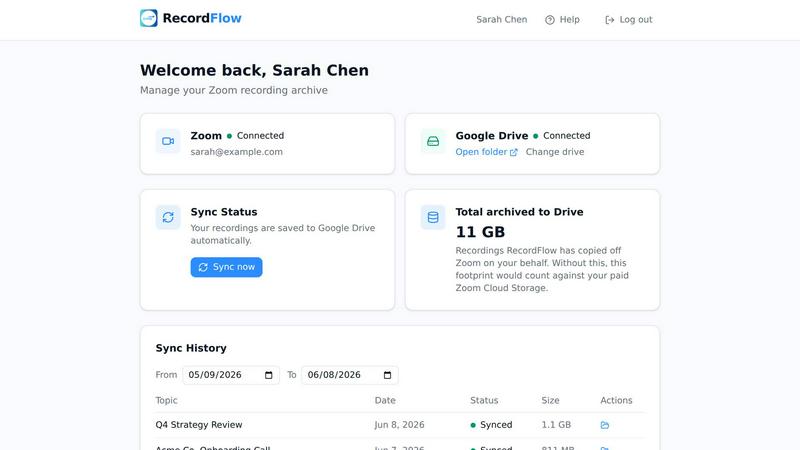
RecordFlow is a specialized automation tool that seamlessly bridges Zoom and Google Drive, eliminating the tedious and error-prone process of manually transferring cloud recordings. The product automatically archives every Zoom cloud recording to a designated Google Drive folder the moment a meeting ends, and it can backfill recordings from the past two years. This solves a critical pain point for professionals who rely on Zoom recordings as essential records or deliverables, such as coaches, consultants, therapists, professors, and small teams. The core value proposition is simple: no more manual downloads, no forgotten files, and no need to pay for Zoom storage that quickly runs out. Setup is remarkably fast, taking approximately 60 seconds to sign in with Zoom, connect a Google Drive account, and select a destination folder. After that, new recordings sync automatically and forever. The tool transfers every file type Zoom produces, including video (MP4), audio (M4A), transcripts (VTT and a formatted Google Doc), and chat logs, all organized by year and date. An optional auto-delete feature can safely remove recordings from Zoom on a configurable delay once the Drive copy is verified, freeing up valuable Zoom storage. RecordFlow is built for reliability, using chunked transfers for large files, smart deduplication to allow safe re-runs, and automatic retries. Critically, recordings stream directly to the user's Google Drive without ever being stored on RecordFlow's servers, and the service employs OAuth 2.0 and AES-256 encryption for security. It is recognized by the International Association of Coaches, Therapists and Mentors and is available on both the Zoom App Marketplace and Google Workspace Marketplace.
Features of RecordFlow
Automatic Sync and Backfill
RecordFlow eliminates the need for any manual intervention by automatically detecting when a Zoom cloud recording has finished processing and immediately initiating a transfer to the user's Google Drive. This process happens within minutes of the meeting's conclusion, ensuring that recordings are available in their permanent home almost instantly. Additionally, the tool offers a powerful backfill capability that can scan and transfer all existing cloud recordings from the past two years. This is particularly valuable for new users who have a backlog of important recordings sitting in Zoom's limited storage, allowing them to consolidate everything into their Drive without having to manually download and upload each file.
Comprehensive File Archival
The tool does not just transfer the video file. It archives every single file that Zoom generates for a cloud recording. This includes the primary video in MP4 format, the standalone audio track in M4A, the meeting transcript in VTT format, and a formatted Google Doc version of that transcript, as well as the complete chat log. For users with early access, RecordFlow can also capture AI Companion transcripts and meeting summaries, saving them as Google Docs and Markdown files. All these files are automatically organized within the user's chosen Google Drive folder by year and date, creating a clean, searchable, and logical archive that is far superior to Zoom's default interface.
Safe and Automated Zoom Storage Management
Zoom's cloud storage is a finite and often costly resource. RecordFlow addresses this with an intelligent auto-delete feature. Once the tool has successfully verified that a complete copy of the recording and all its associated files exists in Google Drive, it can automatically delete the recording from Zoom's cloud. This deletion occurs on a safe, configurable delay to provide a buffer for any last-minute needs. This feature frees up Zoom storage automatically, preventing the disruptive scenario where a user hits their storage limit and new recordings are blocked. It allows users to effectively use Zoom as a temporary processing hub and Google Drive as their permanent, unlimited archive.
Reliable Transfer Engine and Security
RecordFlow is engineered for reliability, especially with large files that can cause timeouts in other systems. It uses chunked transfers, breaking down large files into smaller segments that are uploaded in parallel. This prevents the entire transfer from failing if there is a temporary network issue and ensures that even hour-long meetings transfer reliably. The system also features smart deduplication, so it is safe to re-run the sync without creating duplicate files. Automatic retries handle transient errors. From a security standpoint, RecordFlow never stores the recordings on its own servers; the video and audio stream directly from Zoom to Google Drive. It uses industry-standard OAuth 2.0 for authentication and AES-256 encryption for data in transit and at rest, ensuring that user data and credentials are protected.
Use Cases of RecordFlow
Coaches and Consultants Archiving Client Sessions
Coaches and consultants often record multiple client sessions each week. These recordings are not just personal notes; they are often deliverables that clients expect to receive. Zoom's 5 GB Pro storage limit fills up in days, forcing a weekly cycle of manual downloading, uploading to Drive, organizing by client, and deleting from Zoom. RecordFlow automates this entire workflow. When a session ends, the video, audio, and transcript are automatically deposited into a specific client folder in Google Drive. The consultant can then share a direct link with the client immediately, knowing the recording is safely archived and their Zoom storage is being cleared for the next week's sessions.
Education Teams Creating a Permanent Lecture Library
Professors and educational institutions use Zoom to record lectures, but relying on Zoom as the sole repository is risky due to storage limits and retention policies. RecordFlow allows education teams to create a permanent, organized library of lectures in a shared Google Drive. When a lecture finishes, the recording automatically lands in a folder organized by course and date. Students can then access the video, the formatted transcript as a Google Doc for note-taking, and the chat log containing Q&A. This provides a durable, searchable, and easily shareable resource that persists long after the academic term ends and is independent of Zoom's administrative settings.
Business Teams Standardizing Meeting Documentation
In business environments where multiple team members record important client calls, internal strategy meetings, and product demos, RecordFlow can be installed by an IT admin for the entire Zoom account. The admin can then opt-in specific team members. When those members record a meeting, their files are automatically deposited into a central Google Drive folder controlled by the admin, with sub-folders created automatically for each member. This standardizes the archiving process across the company, prevents the loss of institutional knowledge, and ensures that critical recordings are never left behind when a team member leaves the organization.
IT and Operations Admins Managing Organizational Compliance
IT and Ops admins are responsible for data governance and retention policies. RecordFlow provides them with a tool to enforce a consistent backup policy for all Zoom recordings across the organization. The admin can set up a single root folder in Google Drive and automatically archive recordings from all opted-in members. The optional auto-delete feature can be configured to remove recordings from Zoom after a safe delay, preventing users from hoarding storage and ensuring that Zoom's cloud is only used for immediate processing. This gives the admin a single pane of glass for managing the organization's recording assets, ensuring compliance and reducing the risk of data loss.
Frequently Asked Questions
How long does it take for a recording to appear in my Google Drive after a meeting ends?
The sync process begins within minutes of Zoom finishing its cloud recording processing. Zoom itself can take a variable amount of time to process a recording depending on its length and Zoom's server load. Once Zoom has completed processing, RecordFlow detects the new file and initiates the transfer. For most standard-length meetings, the file will appear in your designated Google Drive folder within 5 to 15 minutes after the meeting ends. You will also receive an email notification with a direct link to the recording when the transfer is complete.
Is my data safe and secure with RecordFlow?
Yes, security is a core design principle. RecordFlow never stores your video or audio files on its own servers. The data streams directly from Zoom to Google Drive. The service uses OAuth 2.0 for authentication, meaning it never sees or stores your Zoom or Google password. All data is encrypted with AES-256 encryption both while in transit (between Zoom, RecordFlow, and Google Drive) and while at rest in Google Drive. RecordFlow has passed a security review to be listed on the Zoom App Marketplace and uses minimal Google Drive permissions, only accessing the specific files and folders it creates.
What happens if a recording transfer fails or is interrupted?
RecordFlow is built for reliability with automatic retries. If a transfer fails due to a temporary network issue or a transient error from Zoom or Google Drive, the system will automatically retry the transfer. For very large files, RecordFlow uses chunked transfers, which means the file is broken into smaller pieces. If one chunk fails to upload, only that chunk needs to be retried, not the entire file. This makes the system highly resilient even for hour-long meetings. You will also receive an email notification if a recording is successfully transferred, so you know it is safe.
Can I use RecordFlow to archive recordings for my entire team?
Yes, absolutely. RecordFlow supports an admin installation mode. If you are an admin on a Zoom account, you can install RecordFlow for the entire account. During setup, you can choose which members of your Zoom team you want to include in the archival process. You then point the tool at a single root folder in a shared Google Drive. RecordFlow will automatically create sub-folders for each member and place their recordings inside. This is an ideal solution for IT managers, team leads, and operations admins who want to ensure all company recordings are centrally and safely archived.
Explore more in this category:
Similar to RecordFlow

tallycounterweb.com
Tally Counter is a simple online counting tool for tracking attendance, workouts, inventory, sports scores, visitors, and everyday activities.

iHatePosting
Social media scheduler to create once, customize per platform, and publish across 14 networks from one dashboard.

PDFWix
PDFWix is a free online PDF toolkit designed to make everyday PDF tasks simple, fast, and private.

PDFKing
Free online PDF tools to merge, compress, convert, edit, sign, and manage documents—no signup, watermarks, or daily limits.

StyleCut
StyleCut lets you see how different hairstyles look on your own face before committing to a cut.


OctoWatch DLP
Track staff & time. Free trial. Cloud/on-prem.