

Clypto
Clypto enables instant low-fee cross-chain swaps for over 6,000 tokens across 16 blockchains with best rates and deep liquidity.
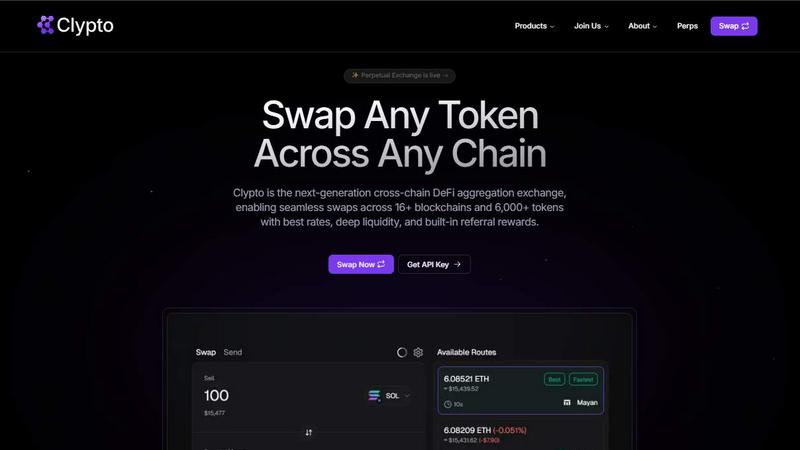
About Clypto
Clypto is a next-generation cross-chain decentralized finance (DeFi) aggregation exchange that revolutionizes how users swap cryptocurrencies across disparate blockchain networks. Unlike traditional platforms that rely on cumbersome and often insecure bridge protocols, Clypto employs an advanced smart routing engine that aggregates liquidity from leading decentralized exchanges (DEXs) and bridges, ensuring users consistently obtain the best possible exchange rates with minimal slippage. The platform supports over 16 blockchains, including Bitcoin, Ethereum, Solana, Dogecoin, Litecoin, and Avalanche, and provides access to more than 6,000 tokens, making it one of the most comprehensive cross-chain swap solutions available today. Clypto is built on a non-custodial architecture, meaning users retain complete control over their private keys and funds at all times, eliminating counterparty risk associated with centralized exchanges. The platform serves a diverse audience: individual traders seeking efficient and cost-effective trading solutions, developers looking to integrate robust cross-chain swap APIs into their applications, and institutions aiming to streamline their DeFi operations with enterprise-grade reliability. Clypto's unique value proposition lies in its ability to simplify cross-chain trading by providing a single, intuitive interface that abstracts away the complexity of multiple blockchains, bridges, and liquidity sources. Additionally, the platform features a built-in referral rewards system that allows users and developers to monetize every transaction through flexible fee sharing, creating an ecosystem where participants are incentivized to drive volume. With a focus on speed, security, and user experience, Clypto is positioned as the go-to infrastructure for seamless cross-chain DeFi interactions.
Features of Clypto
Smart Routing Engine
Clypto's core technology is its advanced smart routing engine, which dynamically analyzes and aggregates liquidity from top decentralized exchanges and bridge protocols in real-time. The engine evaluates multiple parameters, including token availability, liquidity depth, network fees, and execution speed, to construct the most optimal swap path for each transaction. This ensures users consistently receive the best possible exchange rates with minimal slippage, even for large or illiquid token pairs. The routing engine continuously adapts to changing market conditions, providing a significant advantage over manual trading across multiple platforms.
Cross-Chain Compatibility
Clypto enables seamless swaps across more than 16 distinct blockchain networks, including EVM-compatible chains like Ethereum and Avalanche, as well as non-EVM chains such as Bitcoin, Solana, Dogecoin, and Litecoin. This broad compatibility eliminates the need for users to manage multiple wallets or navigate complex bridge interfaces. The platform handles the underlying cross-chain messaging and asset transfers transparently, allowing users to move value between ecosystems like Bitcoin and Solana with a single click. This feature is essential for traders seeking exposure to diverse blockchain ecosystems without operational friction.
Non-Custodial Architecture
Security is paramount in DeFi, and Clypto's non-custodial design ensures that users retain full ownership and control of their private keys and funds throughout the swap process. The platform never takes custody of user assets; instead, it facilitates peer-to-peer atomic swaps and smart contract interactions that execute directly from the user's wallet. This architecture eliminates the risk of exchange hacks, exit scams, or frozen funds that plague centralized platforms. Users can transact with confidence, knowing their assets remain under their sole control at all times.
Built-In Referral Rewards
Clypto incorporates a native referral rewards system that allows users, developers, and partners to earn passive income from every transaction they facilitate. The system supports flexible fee sharing, where referrers can set their own referral fee basis points (bps) and earn a percentage of the swap volume generated through their unique referral links or integrated APIs. This feature transforms every user into a potential revenue generator, incentivizing community growth and platform adoption. Developers integrating Clypto's API can also leverage this system to monetize their applications directly.
Use Cases of Clypto
Individual Cross-Chain Trading
Retail traders can use Clypto to efficiently swap tokens across different blockchains without the complexity of managing multiple bridge protocols or centralized exchange accounts. For example, a trader holding Bitcoin on the Bitcoin network can seamlessly convert it to Ethereum or Solana-based tokens in a single transaction, accessing diverse DeFi opportunities like lending, staking, or yield farming. The smart routing engine ensures they receive competitive rates, while the non-custodial architecture protects their funds from exchange-related risks.
Developer API Integration
Developers building DeFi applications, wallets, or trading interfaces can integrate Clypto's powerful Aggregation API to add cross-chain swap functionality in minutes. The API provides endpoints for querying supported chains, fetching token lists, obtaining real-time quotes, and executing swap transactions. This allows developers to offer their users seamless cross-chain trading without building complex bridging infrastructure from scratch. The API also supports referral fee integration, enabling developers to generate revenue from their application's swap volume.
Institutional DeFi Operations
Institutions managing multi-chain portfolios or executing large-scale trades can leverage Clypto's enterprise-grade infrastructure to streamline their operations. The platform's deep liquidity aggregation, fast API response times, and 99.99% uptime ensure reliable execution for high-value transactions. Institutions can automate cross-chain rebalancing, arbitrage strategies, or liquidity provisioning using Clypto's API, reducing operational overhead and minimizing slippage through optimized routing. The non-custodial model also aligns with institutional security requirements.
Yield Optimization and Arbitrage
Advanced DeFi users can utilize Clypto to identify and execute cross-chain arbitrage opportunities or optimize yield strategies. By swapping assets between chains where price discrepancies or yield differentials exist, users can capture value that would otherwise be inaccessible through single-chain platforms. Clypto's smart routing engine automatically finds the most cost-effective path, including multi-hop swaps that leverage intermediate tokens or liquidity pools, maximizing returns while minimizing transaction costs and execution risk.
Frequently Asked Questions
How does Clypto ensure the best swap rates?
Clypto's smart routing engine aggregates liquidity from multiple decentralized exchanges and bridge protocols in real-time. When a user requests a quote, the engine evaluates all available paths, considering factors like token liquidity, network fees, and slippage. It then selects the optimal route that provides the best net output for the user. This process happens within milliseconds, ensuring users consistently receive competitive rates without manually comparing multiple platforms.
Is Clypto safe and non-custodial?
Yes, Clypto is built on a non-custodial architecture, meaning users retain full control of their private keys and funds at all times. The platform never holds or manages user assets; instead, it facilitates atomic swaps and smart contract interactions that execute directly from the user's wallet. This design eliminates the risk of exchange hacks, fund freezes, or unauthorized access. Users should always verify transaction details before signing and use secure wallet practices.
Which blockchains and tokens does Clypto support?
Clypto currently supports over 16 blockchain networks, including Bitcoin, Ethereum, Solana, Avalanche, BNB Chain, Dogecoin, Litecoin, and THORChain, among others. The platform provides access to more than 6,000 tokens across these chains. The supported networks and tokens are continuously expanding as new integrations are added. Users can check the platform or API documentation for the most up-to-date list of supported assets.
How can developers integrate Clypto's API?
Developers can integrate Clypto's cross-chain swap functionality by obtaining an API key from the Clypto website. The platform provides a comprehensive API SDK (e.g., @clypto/api-sdk) with clear documentation for querying supported chains, fetching token lists, obtaining real-time quotes, and executing swap transactions. The API also supports setting referral fees, allowing developers to monetize their applications. Integration typically takes minutes, and the SDK handles the complex cross-chain logic behind the scenes.
Pricing of Clypto
Clypto does not charge platform fees for individual swaps. The costs incurred by users are limited to network transaction fees (gas fees) required by the underlying blockchains and any fees charged by the liquidity providers or bridge protocols used in the swap path. The platform generates revenue through optional referral fee mechanisms and enterprise API licensing. Detailed pricing for enterprise API access and volume-based fee structures is available upon request by contacting the Clypto team. There are no subscription tiers or upfront costs for basic usage.
Similar to Clypto


Polymarket Trading Bot For Crypto
This bot automates high-frequency arbitrage and directional trading on Polymarket's 5-15 minute crypto markets, replicating a proven profitable.


Bitcoin Loans Market
Bitcoin Loans Market lets you compare every major Bitcoin-backed loan by APR, LTV, custody, and rehypothecation to find the right fit for your coins.

Autheo
Autheo is a unified Layer-0 and Layer-1 OS that streamlines identity, compute, storage, and AI for seamless Web3 application development.

Perpfinder
Perpfinder provides real-time rankings and data for volume, fees, and open interest across 30+ crypto perpetual exchanges.