

xyOps
xyOps is a next-generation workflow automation system that unifies job scheduling, monitoring, alerting, and ticketing for your entire infrastructure.
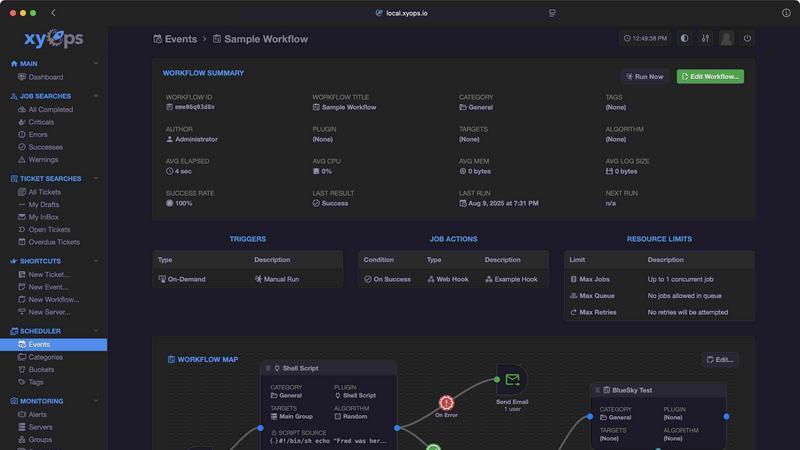
About xyOps
xyOps is a next-generation, open-source platform that consolidates job scheduling, workflow automation, server monitoring, alerting, and incident response into a single, cohesive system. Designed for developers and operations teams, xyOps provides complete control over your automation stack without compromising on data privacy, operational freedom, or visibility. Unlike many modern tools, xyOps does not hide essential features behind paywalls, and it never pushes telemetry data back to external servers. It is built to be open, extensible, and capable of running anywhere, from a single laptop to a fleet of thousands of servers. The platform offers a visual workflow builder, a flexible job scheduler that goes far beyond traditional cron, real-time job tracking with resource limits, comprehensive server monitoring with custom metrics, and a smart alerting system that can trigger complex actions. Additionally, xyOps includes an integrated ticketing system for incident response, a plugin architecture that supports any programming language, and a growing marketplace of ready-made plugins. With its BSD 3-Clause licensing, xyOps ensures that all current and future features remain free and open source forever, giving teams the freedom to customize, extend, and deploy without restrictions. Whether you need to automate routine maintenance, orchestrate complex CI/CD pipelines, or monitor critical infrastructure, xyOps provides a unified, developer-friendly solution that scales with your needs.
Features of xyOps
Visual Workflow Builder
xyOps features a graphical workflow editor that allows you to chain multiple jobs together with conditional logic, pass data and files between steps, and assign actions to events such as notifications or webhooks. You can attach limiters like timeouts, memory caps, and log size caps to each step, run jobs in parallel, or create custom queues for sequential execution. This visual approach makes complex automation pipelines easy to design, understand, and maintain.
Flexible Job Scheduler
Go beyond traditional cron with xyOps' powerful job scheduler. You can target individual servers or entire groups, set multiple schedules per event, define blackout ranges for holidays or downtime, and import existing crontab configurations. The scheduler also supports one-time jobs for single-shot executions and plugin-based scheduler extensions, giving you complete flexibility to run tasks exactly when and where you need them.
Active Job Tracking
Run any number of jobs in parallel with optional max parallel limits that queue the rest. xyOps provides real-time progress updates, time remaining estimates, and the ability to enforce CPU and memory usage limits per job. Your jobs can emit their own progress and stats, and you can run custom actions based on the job result. This level of visibility ensures you always know the status of your automation.
Smart Alerts
xyOps offers rich alerting with full customization and complex trigger expressions. Alerts can be sent via email, webhook, or custom notification channels, and each alert includes a snapshot of the server at the time of the event. Alerts can automatically create tickets or trigger new jobs, and active alerts can even prevent new jobs from launching, providing a proactive approach to incident management.
Use Cases of xyOps
Automating Server Maintenance and Updates
Operations teams can use xyOps to schedule routine maintenance tasks such as system updates, log rotation, and disk cleanup across a fleet of servers. By grouping servers and applying schedules with blackout ranges, teams can ensure maintenance occurs during off-peak hours without disrupting critical services. Real-time tracking and alerts provide immediate notification if any task fails.
Orchestrating CI/CD Pipelines
Development teams can leverage xyOps to build and manage complex CI/CD pipelines. The visual workflow builder allows chaining of build, test, and deployment jobs with conditional logic. Data and artifacts can be passed between steps, and integrated ticketing can automatically create tickets for failed builds. This streamlines the release process and improves collaboration.
Monitoring and Incident Response for Critical Infrastructure
xyOps enables teams to monitor CPU, memory, network, disk, and custom metrics across all servers. When a threshold is breached, smart alerts can trigger immediate actions such as creating a ticket, running a remediation job, or notifying the on-call team via email or webhook. The integrated ticketing system ensures all incidents are tracked and resolved systematically.
Scheduled Data Processing and Reporting
Data engineering teams can schedule complex data processing jobs that run on specific dates or intervals. Using the visual workflow editor, they can chain extraction, transformation, and loading steps, enforce memory and time limits, and pass files between jobs. Alerts can notify stakeholders when reports are ready or if a data pipeline fails, ensuring data integrity.
Frequently Asked Questions
Is xyOps truly free and open source?
Yes, xyOps is 100% free and open source under the BSD 3-Clause license. The license will never be modified, split, or amended with additional restrictive terms. All current and future app features will remain open source forever. Professional and enterprise support plans are available separately, but the core platform and all its features are completely free.
What operating systems does xyOps support?
xyOps agents can be easily installed on macOS, Linux, and Windows. The platform is designed to run anywhere, from a single development machine to a large cluster of thousands of servers. The server component itself can be deployed on any system that supports the required runtime environment.
Can I write custom plugins for xyOps?
Absolutely. xyOps uses a simple JSON over STDIO Plugin API that requires no SDK and supports all programming languages. You can define custom parameters with UI form fields, and create different plugin types including Event, Action, Monitor, and Trigger. Plugins can be published to the Plugin Marketplace for others to use.
How does xyOps handle scalability and redundancy?
xyOps supports running multiple hot backups that can take over instantly on primary failover, with no interruption to running jobs. The platform scales to thousands of worker servers in your cluster, and you can group servers manually or automatically based on hostname. This ensures high availability and performance for even the largest infrastructures.
Similar to xyOps


iHatePosting
Social media scheduler to create once, customize per platform, and publish across 14 networks from one dashboard.

connect machine
privacy-first, AI-powered contact management platform

Wisegrid
Spreadsheet-native work management with AI formulas, dashboards, automation, reporting, and project views for growing teams.

Postqued
Schedule and publish social content across 10 platforms with one dashboard, API, and MCP built for teams and AI agents.

Groniz
Run your social media on autopilot with AI agents. Post & schedule to 32+ networks from Claude Code, Codex, or Console.

AIQuality
AIQuality delivers instant deterministic scores and optimization suggestions to improve your AI prompts while protecting privacy.

EchoLeads AI
EchoLeads AI uses intelligent voice agents to automate cold calling, lead qualification, and appointment scheduling across multiple channels.