

Shadcn Examples
A library of ready-made React and Tailwind UI components and templates for building modern web apps.
About Shadcn Examples
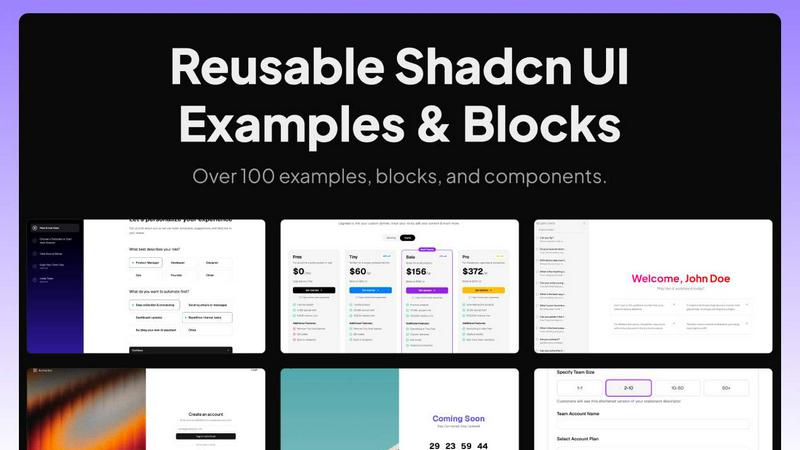
Shadcn Examples is a comprehensive library of pre-built, production-ready UI examples and blocks specifically designed for developers using the shadcn/ui component system. While shadcn/ui provides excellent foundational components like buttons, cards, dialogs, and forms through its copy-pasteable approach and Radix UI primitives, it does not include complete page layouts or application templates. This is the gap that Shadcn Examples fills. The platform offers a curated collection of fully functional templates, including admin dashboards, e-commerce checkout flows, kanban boards, chat applications, file managers, music apps, social media templates, and marketing sections. Each example is built using the same core stack of React, Tailwind CSS, shadcn/ui, and Radix UI, ensuring consistency and seamless integration into existing projects. The library is designed for developers building SaaS products, internal tools, web applications, or any project that requires polished, responsive interfaces without starting from scratch. By providing complete, copy-pasteable blocks, Shadcn Examples transforms shadcn/ui from a component library into a shipping-ready UI kit, significantly reducing development time. The platform also supports multiple frameworks including Next.js, Vue.js, and Svelte, and all examples are TypeScript compatible. With a steady release cadence and a growing catalog, Shadcn Examples has become a valuable resource for developers who want to maintain full control over their code while accelerating their workflow.
Features of Shadcn Examples
Extensive Pre-Built Template Library
The core offering of Shadcn Examples is its extensive and growing library of pre-built UI templates and blocks. This includes over a dozen categories such as admin dashboards, chat apps, file managers, kanban boards, music apps, social media apps, bento grids, todo lists, note apps, settings pages, notifications pages, roles and permissions pages, and e-commerce forms like add product forms. Each template is a complete, functional page or application section, not just a single component. This breadth of catalog allows developers to find a starting point for almost any common interface pattern, from complex data management dashboards to simple marketing layouts, saving hours of design and development work.
Consistent Technology Stack
All examples on Shadcn Examples are built on a consistent and modern technology stack, ensuring seamless integration into existing projects. The primary stack includes React for the UI library, Tailwind CSS for utility-first styling, shadcn/ui for accessible and customizable components, and Radix UI for low-level, headless primitives. This consistency means that developers do not need to learn new patterns or adapt to different styling methodologies when moving between examples. Furthermore, the library supports multiple meta-frameworks including Next.js, Vue.js, and Svelte, and all code is fully TypeScript compatible, providing type safety and better developer experience out of the box.
Copy-Pasteable and Fully Customizable Code
True to the shadcn/ui philosophy, every example and block on Shadcn Examples is designed to be copy-pasteable directly into your project. The source code is fully exposed, giving developers complete control to modify, extend, and customize every aspect of the template. There are no black-box components or restrictive licenses that limit how you use the code. This approach empowers developers to treat the examples as a starting point, not a final product, allowing them to adapt the layout, styling, and functionality to meet their specific project requirements. The code is clean, well-structured, and follows best practices for React and Tailwind CSS.
Live Preview and Easy Exploration
Shadcn Examples provides a robust live preview feature for every template in its library. This allows developers to interact with the full functionality of a dashboard, app, or block directly in the browser before deciding to use it. The website also features a powerful search and command palette, enabling users to quickly find specific examples by keyword or category. The homepage organizes examples into logical sections like "Recently Added," "Featured Examples," and category-specific groups such as "Admin Dashboard Examples" and "E-Commerce Examples," making navigation intuitive and efficient. This focus on discoverability ensures developers can quickly locate the exact template they need.
Use Cases of Shadcn Examples
Building SaaS Admin Dashboards
One of the primary use cases for Shadcn Examples is accelerating the development of SaaS admin dashboards. The library includes multiple admin dashboard templates, dashboard layouts, and supporting pages like settings, notifications, and roles and permissions. A developer building a new SaaS product can start with a complete admin dashboard template, which typically includes a sidebar navigation, header, main content area with data tables and charts, and user management sections. Instead of spending days wiring together individual components and layouts, they can copy the template, modify the branding and data sources, and have a functional admin interface in hours. This dramatically reduces the time to first deploy for internal tools and customer-facing dashboards.
Creating E-commerce and Product Management Interfaces
For developers building e-commerce platforms or any application requiring product management, Shadcn Examples offers ready-to-use templates like add product forms and other e-commerce blocks. These templates include complex form elements, validation patterns, and layout structures that are notoriously time-consuming to build from scratch. A developer can take the add product form template, which includes fields for product name, description, pricing, images, and categories, and integrate it directly into their application. This use case is particularly valuable for internal tools where rapid prototyping is essential, or for marketplaces where consistent product listing interfaces are required across different vendor dashboards.
Developing Communication and Collaboration Tools
Shadcn Examples provides templates for chat applications, kanban boards, and social media apps, making it an excellent resource for building communication and collaboration tools. A team building an internal communication platform can start with the chat app template, which includes message lists, input fields, user avatars, and conversation threads. Similarly, a project management tool can be quickly assembled using the kanban board template, which provides drag-and-drop task management with columns for "To Do," "In Progress," and "Done." These templates handle the complex layout and interaction patterns common in collaboration software, allowing developers to focus on backend integration and unique features rather than reinventing the UI wheel.
Rapid Prototyping for Internal Tools and MVPs
Beyond specific application types, Shadcn Examples serves as a general-purpose toolkit for rapid prototyping of any web application. Whether a developer needs a file manager interface for a cloud storage MVP, a music app layout for a media streaming concept, or a bento grid for a marketing landing page, the library provides a starting point. For startups and internal tool builders, speed is critical. The ability to copy a complete, functional UI block and customize it within minutes allows teams to validate ideas, demo concepts to stakeholders, and iterate on user feedback much faster than building from scratch. This use case makes Shadcn Examples a valuable asset for any development team practicing agile or lean methodologies.
Frequently Asked Questions
What is the difference between shadcn/ui and Shadcn Examples?
Shadcn/ui is a collection of individual, copy-pasteable UI components built on Radix UI primitives, such as buttons, cards, dialogs, and forms. It provides the building blocks for an interface. Shadcn Examples is a separate library that uses those same components to build complete, functional page layouts and application templates, such as admin dashboards, chat apps, and kanban boards. In short, shadcn/ui gives you the parts, while Shadcn Examples gives you the finished product. Both follow the same philosophy of full code ownership and customization.
Which frameworks and technologies are supported by Shadcn Examples?
All examples on Shadcn Examples are built using React as the core UI library, Tailwind CSS for styling, shadcn/ui for components, and Radix UI for accessible primitives. The templates are also compatible with popular meta-frameworks including Next.js, Vue.js, and Svelte. Additionally, every example is fully TypeScript compatible, providing type safety and improved developer experience. This consistent technology stack ensures that developers can integrate examples into their projects with minimal friction, regardless of which framework they are using.
Can I customize the code from Shadcn Examples?
Yes, full customization is a core principle of Shadcn Examples. Following the same philosophy as shadcn/ui, all code is provided as copy-pasteable source files that you own entirely. There are no compiled or obfuscated components. You are free to modify the styling, layout, functionality, and logic of any template to fit your specific project requirements. This approach gives developers complete control over their codebase without any restrictions or limitations, making the library suitable for both personal projects and commercial applications.
How often are new examples added to the library?
Shadcn Examples maintains a steady release cadence, with new examples and blocks being added regularly. The website features a "Recently Added" section that highlights the newest templates, ensuring users are always aware of fresh content. This commitment to continuous updates means the library is constantly expanding to cover more use cases and interface patterns. Developers can expect to find new categories and improvements to existing templates over time, making the library an evolving resource that grows with the needs of its user community.
Similar to Shadcn Examples

Unifyca
Unifyca centralizes WordPress client website documentation, maintenance, and backups into one organized platform for complete agency control.