

Serro AI
Serro AI is a coordination layer that keeps human-agent teams aligned by automatically capturing and sharing live program context across your tools.
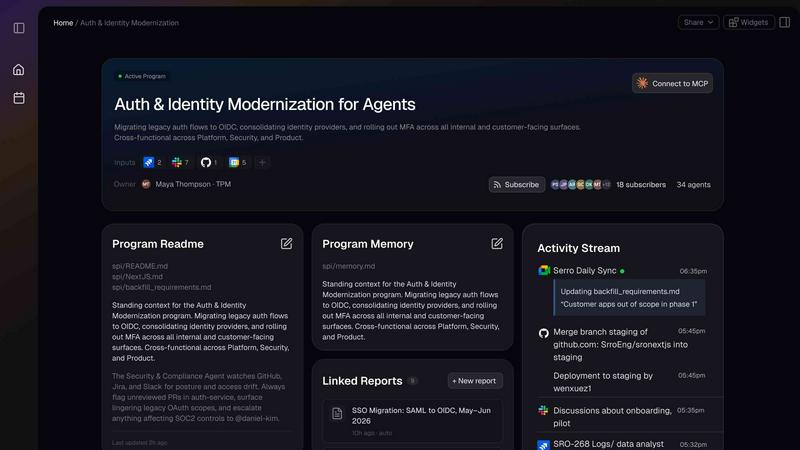
About Serro AI
Serro AI is an Agentic Technical Program Management (TPM) platform, purpose-built to serve as the infrastructure for Program Engineering within modern engineering organizations. Unlike traditional task trackers, roadmap tools, documentation platforms, dashboards, code-wikis, or generic project management systems, Serro treats programs as first-class units of work. It addresses a critical bottleneck in modern engineering: while AI has dramatically increased code output and decision velocity, coordination capabilities have not scaled accordingly. Serro solves this by transforming scattered execution signals from tools like Jira, GitHub, Linear, Slack, documents, meetings, and roadmaps into two core capabilities. First, it creates trusted temporal program memory, a living, continuously updated record of shared goals, decisions, risks, dependencies, and historical context for every program. Second, it enables real-time status coordination that both human team members and AI agents can act upon directly. Serro meets teams where they already work, allowing interaction through meetings, chat, and existing tool integrations. The platform offers two primary editions: Serro Pro helps enterprises scale existing TPM capacity, enabling TPMs, Engineering Managers, Product Managers, and engineering leaders to collaboratively manage downstream program execution and agent loops. Serro Lite gives earlier-stage companies AI-powered TPM capacity much sooner, allowing smaller teams to scale their live coordination without dedicated program management staff. Serro is built for the next generation of engineering teams where human expertise defines direction and AI accelerates execution.
Features of Serro AI
Program Memory
Serro maintains live, continuously updated memory across every active program. This system captures decisions, risks, owners, history, and activity automatically as work progresses across connected tools. Instead of reconstructing context after meetings or digging through disparate systems, teams have instant access to a trusted, temporal record of what happened, why decisions were made, and what the current state of the program is. This memory serves as the single source of truth for both human collaborators and AI agents, eliminating the friction of context switching and information retrieval.
Loops on Programs
Serro implements automated loops that keep complex, multi-team work moving forward efficiently. These loops handle recurring coordination tasks such as status updates, dependency tracking, blocker escalation, and follow-through on meeting outcomes. By automating these repetitive coordination patterns, Serro frees technical program managers and engineering leaders to focus on higher-value strategic work. The loops are configurable and adapt to the specific rhythms and requirements of each program, ensuring that nothing falls through the cracks while maintaining alignment across distributed human-agent teams.
Agent Governance
Serro provides a comprehensive control layer for managing both programs and AI agents operating within them. This governance system ensures that agents act within defined boundaries, follow program rules, and adhere to organizational policies. It includes controls for agent permissions, scope of action, escalation paths, and audit trails. As teams increasingly incorporate AI agents into their workflows, Serro ensures these agents remain aligned with human intent and program objectives, preventing autonomous actions from causing coordination failures or security risks.
Program Analytics
Serro delivers a system-level view across the entire organization, providing real-time insights into program health, momentum, blockers, coordination gaps, and operational risk. These analytics transform fragmented updates from multiple tools into a coherent, live picture of organizational reality. Engineering leaders, product managers, and executives can make faster, more informed decisions based on accurate, current data rather than stale status reports. The analytics layer also enables trend analysis, resource optimization, and early warning detection for programs that may be at risk of derailing.
Use Cases of Serro AI
Technical Program Managers Scaling Impact
Technical Program Managers (TPMs) use Serro to delegate coordination overhead and scale their impact across multiple cross-functional programs. Instead of manually tracking status, chasing updates, and reconciling information from Jira, Slack, and meetings, TPMs rely on Serro to maintain live program memory and automate coordination loops. This allows them to run more programs simultaneously, maintain higher quality of execution, and focus on strategic problem-solving rather than administrative tasks. The platform provides a single live view of timelines, blockers, ownership, and reporting for all active programs.
Engineering Managers Gaining Real-Time Visibility
Engineering Managers (EMs) use Serro to understand execution reality without chasing updates from their teams. The platform gives them a shared view of what is moving across teams, where execution is slipping, and what needs attention next. EMs can stay close to delivery progress, risk factors, and team health through automatically generated summaries and alerts. This eliminates the need for frequent status meetings and manual report creation, allowing EMs to spend more time on coaching, architecture, and removing blockers for their teams.
Product Managers Aligning Roadmaps with Execution
Product Managers (PMs) use Serro to keep decisions, timelines, and execution aligned as priorities evolve. The platform connects roadmap shifts to delivery progress, ensuring that product direction remains tied to actual engineering output. PMs can track how decisions made in planning sessions translate into real work, identify when scope changes impact timelines, and communicate trade-offs clearly to stakeholders. Serro provides the shared context needed for PMs to maintain alignment between business goals and technical execution across multiple teams and dependencies.
Engineering Leadership Monitoring Organizational Health
Engineering leaders and executives use Serro to see organizational health in real time. Instead of relying on fragmented updates from multiple sources, they get a clear, consolidated view of momentum, blockers, coordination gaps, and operational risk across all programs. This enables faster, more informed strategic decisions about resource allocation, priority adjustments, and intervention needs. The system-level analytics help leaders identify patterns, predict bottlenecks before they become critical, and ensure the entire engineering organization is aligned on the most important objectives.
Frequently Asked Questions
How does Serro differ from traditional project management tools like Jira or Asana?
Serro is fundamentally different from task trackers and project management platforms. While tools like Jira focus on individual tasks and tickets, Serro treats entire programs as first-class units of work. It ingests signals from multiple tools including Jira, GitHub, Linear, Slack, and meetings to create a living, temporal memory of program context including decisions, risks, dependencies, and history. Traditional tools require manual updates and context reconstruction, while Serro automatically maintains current program state and enables both humans and AI agents to act on real-time coordination signals.
What tools does Serro integrate with and how does the setup work?
Serro connects with your existing engineering stack including Slack, Linear, GitHub, Jira, Zoom, Notion, email, and your codebase. Setup begins by connecting these tools, and Serro immediately starts ingesting signals to discover your active programs. It surfaces the work you are already running, and you simply name programs, assign ownership, and decide what is shared. The platform requires minimal configuration because it reads existing workflows and tools rather than requiring teams to adopt new processes.
Can Serro work with AI agents and how does governance function?
Yes, Serro is specifically designed for human-agent teams. It includes an Agent Governance system that serves as the control layer for programs and agents. This system ensures AI agents operate within defined boundaries, follow program rules, and adhere to organizational policies. Agents can query program state, generate updates on cadence, and turn meeting outcomes into action, but all autonomous actions are governed by permissions and escalation paths that keep human oversight in place.
Is Serro suitable for smaller teams or only large enterprises?
Serro offers two editions to serve different organizational sizes. Serro Pro is designed for enterprises with existing TPM capacity, helping them scale coordination across larger teams and agent loops. Serro Lite gives earlier-stage companies AI-powered TPM capacity much earlier, allowing smaller teams to scale their live coordination without dedicated program management staff. Both editions provide the same core program memory and coordination capabilities, scaled to match the team's size and complexity.
Similar to Serro AI


ContextBolt SEO
Research keywords, competitors, backlinks and AI visibility in Claude or Codex. Keep the findings in your SEO dashboard.

Packing List Generator
Weather-based packing lists for your destination, dates and travel style.


connect machine
privacy-first, AI-powered contact management platform